Introduction
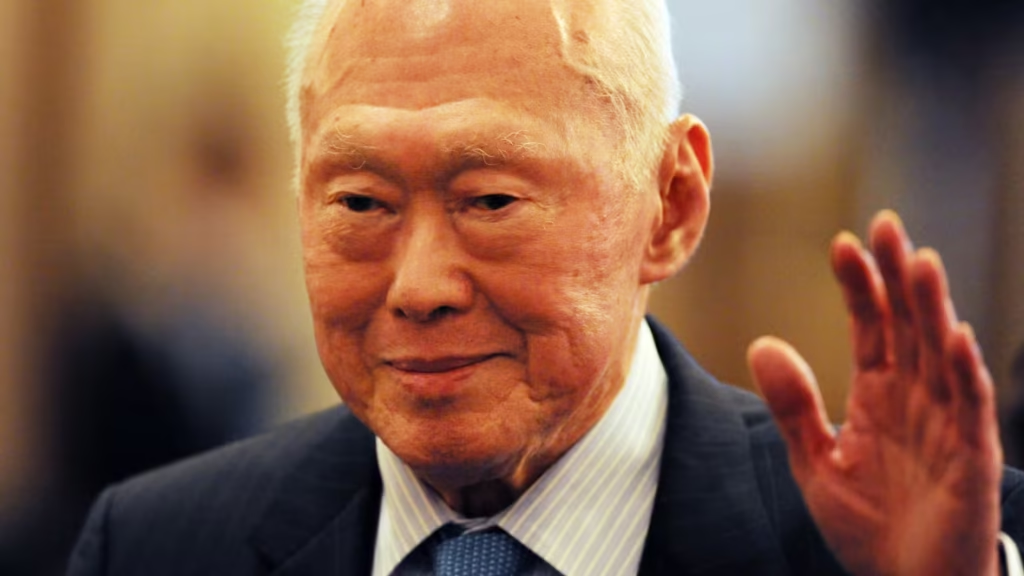
Lee Kuan Yew (1923 – 2015) was more than the founding Prime Minister of Singapore — he was the architect of a nation. Under his leadership, a small, resource-poor island transformed from a struggling post-colonial port into one of the world’s most prosperous, clean, and advanced economies. Often called “the father of modern Singapore,” Lee’s life was defined by vision, discipline, and a relentless belief in progress.
Early Life and Education
Born on September 16, 1923, in Singapore (then part of British Malaya), Lee came from a middle-class Chinese family. He was known as “Harry Lee” during his early years.
His education began at Raffles Institution and later at Raffles College, where he excelled academically. After World War II and the Japanese occupation of Singapore, Lee went to Cambridge University in England, graduating with First-Class Honours in Law in 1949. He was called to the bar at Middle Temple in London and returned home deeply inspired by Western ideas of democracy — yet determined to shape them for Asia’s realities.
Rise in Politics
Upon returning to Singapore, Lee worked as a lawyer and quickly became involved in anti-colonial movements. In 1954, he co-founded the People’s Action Party (PAP) — a political movement dedicated to self-government and eventual independence from British rule.
Through sharp intellect and fiery oratory, Lee led the PAP to victory in the 1959 general elections, becoming Singapore’s first Prime Minister at age 35.
Building a Nation from Scratch
When Singapore gained full independence on August 9, 1965, following its brief merger and separation from Malaysia, the nation faced immense challenges:
- No natural resources
- High unemployment
- Ethnic tensions
- Limited land and water supply
Yet, Lee saw opportunity where others saw crisis.
He focused on four fundamental pillars:
- Economic Development – By inviting foreign investment and building a world-class port, Lee turned Singapore into an industrial and trade powerhouse.
- Education and Meritocracy – He built an education system that emphasized bilingualism and technical excellence.
- Clean and Efficient Government – Corruption was crushed; integrity and merit were rewarded.
- Housing and Infrastructure – Through the Housing and Development Board (HDB), Lee ensured affordable housing for citizens, strengthening national identity and stability.
Leadership Style and Philosophy
Lee Kuan Yew’s leadership was known for its pragmatism and discipline. He often described himself as “a political realist,” choosing results over popularity. His policies balanced economic freedom with social control, emphasizing law, order, and communal harmony.
He famously said:
“I have always thought that humanity was animal until it became civilized by education, discipline, and self-restraint.”
Critics sometimes labeled his style authoritarian, but even they acknowledged his unmatched effectiveness in governance.
Global Impact
Under Lee’s leadership, Singapore became a model admired worldwide — efficient, clean, and corruption-free.
- Per capita GDP grew from about US $500 in 1965 to over US $50,000 by the time he stepped down.
- Global leaders like Bill Clinton, Deng Xiaoping, and Margaret Thatcher praised his strategic wisdom.
- He also played a quiet diplomatic role in fostering strong ties with both the East and West.
Later Years
Lee served as Prime Minister until 1990, when he passed the torch to Goh Chok Tong. He remained active in government as Senior Minister (1990–2004) and Minister Mentor (2004–2011), advising on long-term strategy.
Even after retiring from cabinet in 2011, Lee continued writing and speaking about Singapore’s future. His books, including The Singapore Story and From Third World to First, remain essential reads for anyone interested in leadership and nation-building.
Legacy
Lee Kuan Yew passed away on March 23, 2015, at the age of 91. His death triggered a week of national mourning, with hundreds of thousands lining the streets to pay tribute.
Today, his legacy lives on in Singapore’s:
- World-class infrastructure
- Clean governance
- High standard of living
- Global reputation for excellence and stability
As he once said:
“I have no regrets. I have spent my life, so much of it, building up this country. There’s nothing more that I need to do.”
Lee Kuan Yew’s story is a testament to what visionary leadership, courage, and discipline can achieve. From a tiny island without resources, he built a thriving nation admired across the world. His journey reminds us that great leadership is not about power — it’s about purpose.